


The infrastructure that makes digital teaching possible
A learning platform is worthless if the lecture-hall Wi-Fi collapses at thirty connections. Huawei covers the other half of the problem: the room, the campus network and the research infrastructure.

What we deploy
Our partnership with Huawei, the world leader in ICT infrastructure, lets us offer current technology for transforming learning spaces both physically and digitally. These are not simply pieces of equipment: they are the foundations of a modern, connected and extensible teaching environment.


2 600+
Universities and research institutes served worldwide
Huawei Enterprise · 2026
3
Scenarios: classroom, campus, research
Huawei Enterprise · 2026
9
Customisable solutions in the catalogue
Huawei Enterprise · 2026
The catalogue they are drawn from
Huawei structures its education offering around three moments — the lesson, the campus and research — and nine customisable solutions. Our three come from it; the rest of the catalogue shows what a deployment can grow into.
01
Smart classroom
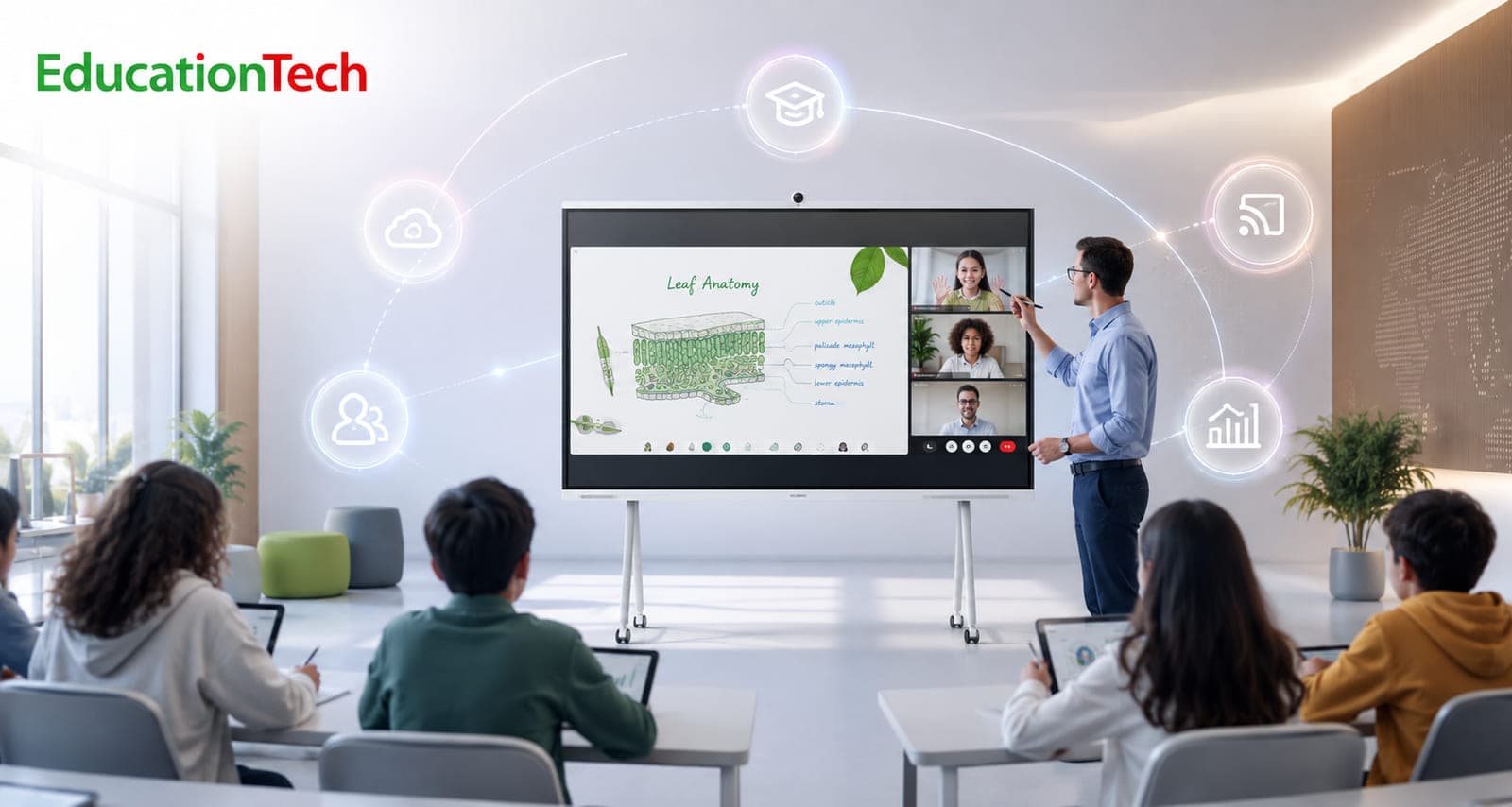
Digitalising the lesson itself: recording, broadcast, cross-site collaboration and blended in-person / remote teaching.
Hybrid learning
One lesson taught in the room and remotely, without the connected students becoming second-class spectators.
Collaborative classroom
Two institutions share one live lesson — useful when a specialist teacher cannot be everywhere.
Digital classroom
Lesson recording and broadcast, building a reusable library instead of starting again each year.
Intelligent collaboration
IdeaHub interactive boards and video conferencing, for staff meetings as much as for teaching.
02
Smart campus
The infrastructure without which none of the rest holds: network, Wi-Fi, safety and centralised management.
School connectivity
A campus wireless network on AirEngine Wi-Fi 7, managed from a cloud platform — run remotely, not school by school.
Smart campus network
Passive optical fibre, gigabit to student accommodation and 10 Gbps to classrooms.
Safe campus
Video security and access control on the same network, rather than a parallel system to administer.
03
Research innovation
What a research group actually needs: compute, storage, and a network that connects them without loss.
High-performance computing (HPC)
A lossless network for intensive compute — simulation and data processing at university-laboratory scale.
NREN
The national research and education network: connecting institutions so resources and work can be shared.
The building blocks
AirEngine Wi-Fi 7
Campus Wi-Fi — sized for full lecture halls, not for an office.
iMaster NCE
Centralised network management, so several sites are run from one place.
Who it’s for
Frequently asked
What exactly do these solutions cover?
Three scenarios: the classroom (hybrid teaching, recording, cross-site collaboration), the campus (network, Wi-Fi, safety) and research (high-performance computing, national networks). Nine solutions in total, combined to suit an institution.
Does it all have to be deployed at once?
No. These solutions are designed to be adopted in stages. Most institutions start with connectivity — nothing else holds without a reliable network — then add digital classrooms.
Will it work with our existing equipment?
The solutions are built on open standards and coexist with in-place infrastructure. A technical audit is part of the scoping phase.
How does this differ from Pearson Solutions?
Pearson carries the teaching content and English certification. Huawei carries the infrastructure that delivers it: the room, the network, the campus. The two combine naturally in one institution.
Let’s talk about your infrastructure
A 30-minute walkthrough, tailored to your institution and what is already in place.